Queen’s Speech…They’re Off to Ascot
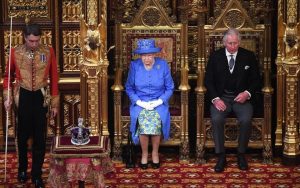 At 11:30 this morning the Queen delivered her speech to the House of Lords and the House of Commons. Here, the Queen set out a rather limited detail agenda for Government over the next two years. The intention is to avoid a Queen’s Speech entirely next year, when we will be mid-way through our negotiations on exiting the EU.
Instead of the usual Royal Regalia, coaches and full pageantry, the Queen arrived by car wearing wore a blue coat and hat (perhaps saving time changing to get to Royal Ascot later in the afternoon).
Her decision not to wear the crown will be seen as a political one, as instead it was placed to one side. A physical demonstration of the fact that the usual ceremony was not taking place due to the delay in the speech taking place.
Having found something to put in the Queen’s Speech, Theresa May must just be relieved that it took place. She did look rather tense as she attempted to engage Jeremy Corbyn in conversation as they crossed Central Lobby into the House of Lords.
So what did we actually get? Instead of a new and exciting legislative programme, we are left with 27 bills being proposed for two years, of which eight relate to Brexit. However, there was very little detail to be had – probably due to the ongoing discussions with the DUP. Instead, it was striking how much of the same language was used that we heard throughout the campaign – minus the Strong and Stable of course.
First on the list seems to be the Great Repeal Bill to repeal the European Communities Act. There was a brief reminder that we do want to stay in touch with our European neighbours. Others may be pleased that the messaging was there for an Open Britain, as we try to ‘forge relationships with other countries’. Like the campaign, there was no detail on what Brexit means and we can only conclude that this discussion has been blown wide open by the election result.
There is some good news for farmers in there though. Not only will business and finance form a major part of the Brexit priorities, but the explicit mention of agriculture and fisheries demonstrates a commitment to food and farming, along with the appointment of controversial, but heavy hitting, Michael Gove as the new Environment Secretary.
After all the furore surrounding the Conservative Manifesto, the Government appears to be trying to wipe the fiasco from British memory, a very limited amount of it appeared in the Queen’s Speech. And most notably of all, instead of the proposed changes to social care, the Government will instead ‘consult’ on the best way forward. We also heard very little about Grammar Schools, another key May policy, which appears to have been dropped like a stone.
On the non-legislative side, one of the major things was the promise that ‘lessons will be learnt’ from the disaster at Grenfell Tower. A full inquiry into the fire will be launched and Hillsborough style co-ordinator appointed. Theresa May has acknowledged that the Government has failed the families at Grenfell Tower. We can only hope that the Government implements legislation to ensure this does not happen again. We will be watching to see what happens with the Housing White Paper.
Big things were made of existing obligations. Michael Fallon was clearly very pleased that we would be honouring our commitment to NATO.
Furthermore, the Prime Minister sought to remind us that she did after all used to be the Home Secretary. Not only will legislation to protect and support domestic violence victims be brought forward, but there will be a review into our Counter Terrorism Strategy (but no legislation – as a newly emboldened Corbyn would oppose it). This is clearly something that needs to be done given the recent terror attacks, not just in the UK but across Europe.
Finally, we might be seeing the end to austerity. The Prime Minister has clearly recognised that the Conservative Party has a perception problem with public sector workers. Much was made of the commitment to ensure greater investment in public services, which may mean the wage cap is removed. This includes fairer funding for schools and more investment in the NHS. We will be watching and waiting to find out more about this.
Overall, we were left thinking about what wasn’t in and how weak Theresa May looked. There is plenty in the programme but May faces a fight on every piece of legislation she tries to pass. This is going to be a long two years – if she makes it through the next 10 days.
Lastest Articles
- Terence Fane-Saunders, continues to be recognised in Spear’s 500 'Top Flight’ reputation management professionals
- A Leader with Genuine Decency
- Chelgate Public Affairs and Consulting Team Expands
- Chelgate Executive Chairman listed in Spear’s ‘Top Flight’ Reputation Managers
- Chelgate Local Planning Success

